

Tidbits On Clean Shaves | The History of Ordinary Things
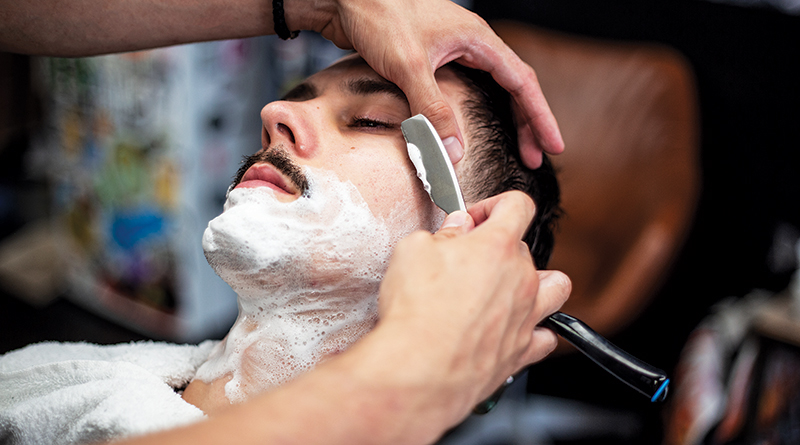
The “straight razor” had a blade that folded into the handle. This razor shape changed very little from the 12th century until the invention of the safety razor. Today their value is determined by the composition of the handle. To sharpen the razor, leather “strops” were used. One side removed rougher chips in the blade, while the other side created a smooth, sharp edge. The back side of the blade was beveled at the precise angle needed when laid flat on the strop.
The straight razor was used for the wet shave. J.B. Williams Company (USA) marketed their first shaving soap, Williams Genuine Yankee Soap, in the 1840s. Initially square, it was changed to a round cake to fit into shaving mugs. Shaving brushes worked up a lather in the mug. Badger hair was prized for brushes because the hair retained the most water.
In 1890, the first Williams Shaving Stick appeared. Later shaving cream came in tubes. In 1918, Williams Co. introduced Aqua Velva, an after-shave lotion.
William Henson invented the hoe-shaped razor in 1847. In 1895, King Camp Gillette combined this shape with the disposable double-edged blade, the Gillette Blue Blade. He introduced the Gillette Safety Razor in 1901. While considered disposable, men re-sharpened the blades multiple times before being discarded into “shaving banks”, or the slot in the back of the medicine cabinet which dropped the razor into the wall. Mechanical strops with a variety of mechanisms were in use.
In 1921, Colonel Schick invented the Magazine Repeating Razor, inspired by the army repeating rifle. The replacement blades were stored in the handle ready to be moved into shaving position without handling. This was a forerunner to the famous Schick Injector Razor. In 1927, Schick introduced Schick electric razor which was followed by others.

In 1960, still marketing the safety razor, Gillette introduced stainless steel blades which lasted longer and didn’t rust. That same year, Bic introduced the 1st totally disposable razor. In 1963, Schick sold Teflon coated stainless steel blades. In 1971, Gillette came out with the 2-blade razor, and so it goes.
You ask, “How had men’s facial hair trends changed over time?” Circa 1840’s, the American male developed the mutton-chop cheek whiskers. Mustaches followed, creating the need for trimming to keep their shape and appearance.
Following the Civil War, the chin hair was abandoned. The handle-bar mustache, heavily waxed, became popular.
During WWI, recruits were issued the Gillette safety razors, which men came to like. Being able to do one’s own shaving resulted in the slow decline, and near extinction, of the barber shave.
There was little change mid-1900s with men (and women) preferring a smooth, clean shave. The hippie movement resulted in the return of whiskers & long natural hair, and you know the rest.
Article by Doris Montag with Excerpts from “Men & Their Hair-Artifacts of Barbering”

> Read Full Biography
> More Articles Written By This Writer
- Tidbits On Clean Shaves | The History of Ordinary Things - March 31, 2026
- How Modern Textiles Came To Be | The History of Ordinary Things - February 27, 2026
- From Cabinet House To Toy House: The History of Ordinary Things - January 30, 2026