

Consistent Donations Provide Critical Blood For Patients
Winter storms and seasonal illnesses have caused a critical need for blood donations, which hospitals rely on to treat their patients.
Whether it’s for trauma patients, surgical cases, or cancer care, donors are the lifeline that keeps hospitals supplied with the blood products needed for life-saving treatment.
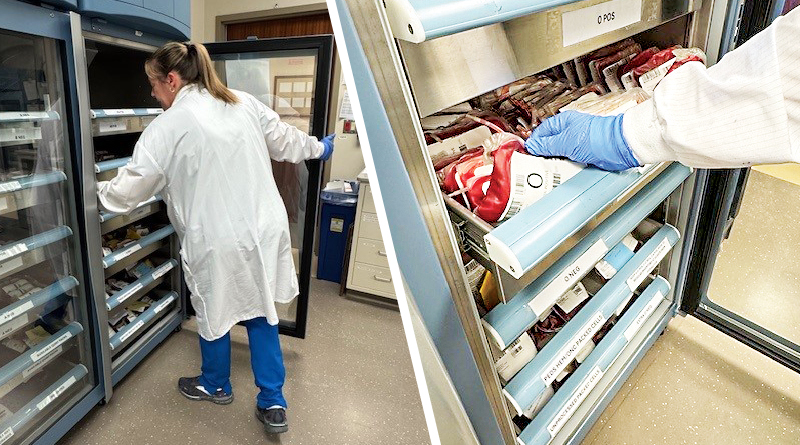
Consistency is essential, and increasingly hard to maintain. Parkview Health transfuses about 15,000 blood products to patients each year across the system, with more than two-thirds of that blood being used at Parkview Regional Medical Center (PRMC) alone.
But Parkview relies on suppliers who rely on donors to keep the blood flowing. Because each type of blood product has a limited shelf life, maintaining an adequate supply and managing the cost of replenishing it hinges on individuals willing to roll up their sleeves and give.
“It’s a really interesting mix of trying not to have too much and have it expire, but also having what we need for our patients,” said Annie Ilnicki, blood bank specialist for Parkview Health. “Being able to balance that is the hardest but most important job. It can be really difficult to keep a steady stream of donations, but all blood donors of all types are extremely valuable.”

Different products, different uses, different shelf life
Blood is a complex fluid made up of several different components, each of which has its own value and use for patients in need.
Parkview stocks and utilizes five of those components, Ilnicki said, which include whole blood, packed red blood cells, plasma, platelets, and cryoprecipitate (cryo).
Whole blood, which is what a donor is likely to give if they drop into a local blood drive, is most often split into the other four components. But sometimes donation centers will leave it whole, for patients who have experienced significant blood loss and need all components at once. Although people commonly think whole blood is what’s used during a transfusion, it actually only accounts for a small portion of what Parkview uses, primarily on its Samaritan helicopters and in the emergency department, Ilnicki said.
Packed red blood cells are by far the most-used blood product, with more than 11,000 units used at PRMC alone last year, Ilnicki said. They are produced by removing most of the plasma from donated blood, creating a concentrated dose of oxygen‑carrying cells. Packed red blood cells can come from whole blood donations or from donations via an apheresis machine, which separates plasma and platelets and returns them to the donor, yielding two to three times more red blood cells.
Yellow-tinted plasma is the liquid portion of blood, mostly made of water, that carries cells, platelets, proteins and nutrients and clotting factors. Plasma can be used to replace fluids in trauma patients, increase clotting ability for people with blood disorders or those undergoing surgery, and serve as a component in other transfusable medicines.
Platelets are cell fragments in your blood that cluster together to stop bleeding when blood vessels are damaged. Cryoprecipitate is a part of the plasma that is rich in clotting factors. Both products are used to slow and stop bleeding in patients or to treat blood disorders that prevent people from clotting properly when injured.
Each of these products have a different shelf life, however, which requires both a steady stream of donations to maintain supply and a balancing act by hospitals to stock what’s needed without having an excess that would eventually be disposed. Each donated product goes through about 3-5 days of rigorous testing for safety before it’s available for use, which also narrows the use-by window.
Most packed red blood cells keep for 42 days after being donated and whole blood is good for 21 days, Ilnicki said. Plasma and cryo can keep for up to a year when frozen, but once thawed, both are on shorter timers. Plasma must be used within five days after thawing, and cryo is only good for six hours once warmed.
Platelets are the most difficult to stock because they’re not donated nearly as often as blood and because they have the shortest shelf life, Ilnicki said. Platelets are only good for five days after collection, but due to the testing requirements, they usually arrive with just two or three days left before expiration.
Donations critical to maintain blood flow
Donors willing to take the time to give blood or plasma or platelets are critical to maintaining a steady inventory of blood products for healthcare, but it’s an increasingly difficult task to maintain a consistent supply.
Parkview sources blood products from three organizations: the American Red Cross, Indianapolis-based Versiti Indiana and South Bend Medical Foundation. But all three of those organizations source their blood from people willing to voluntarily donate.
That’s becoming an increasingly tough ask, even as blood collection organizations work to entice donors with incentives and giveaways, Ilnicki said.
“It can be really difficult to get donations, and we really don’t see that aspect of transfusion medicine getting any better,” Ilnicki said. “The generation that made it a point to get to a blood donation center regularly and donate is getting older, having illnesses, and passing away. There are fewer and fewer regular donors out there.”
The blood donation pipeline can also be impacted by season. Demand for blood is higher during the summer months because there are typically more accidents, injuries or natural disasters when it’s warm out, but supply is often lower because regular donors may miss appointments because of vacations or events, Ilnicki said. Winter is another challenging time for the blood supply, as bad weather or illnesses can also prevent people from making donations, she said.
Becoming a consistent donor is the best way to support the local blood supply, Ilnicki said. But if you don’t feel you can commit to a regular schedule, taking the time to donate during high-need periods (like right now) is a great way to help.
Individuals can donate blood once every eight weeks, but they can donate platelets once every seven days or plasma twice within a seven-day period, with at least a one-day break in between donations. A whole blood donation can typically be completed within an hour or 90 minutes for a double red cell donation via apheresis. Plasma and platelet donations take longer at approximately 90 minutes and 2-3 hours, respectively.
Donating blood products is a commitment, but it’s critical to helping thousands of patients in your communities each year.
“If everybody who donates can get one other person to donate, that will be a big help,” Ilnicki said.

> Read More Information About Us
> More Articles Written By Our Staff
- Equipping Fort Wayne With Practical Tools For Peacemaking - March 16, 2026
- Is Being A ‘Night Owl’ Bad? - March 16, 2026
- Reminder That Spring Is On The Way… & So Are The Kittens! - March 16, 2026