

What Is Sewing Machine Day? | The History of Ordinary Things
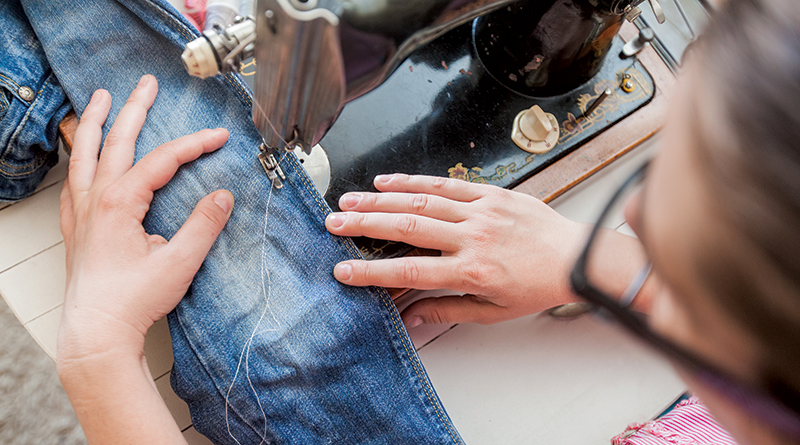
Imagine life without the sewing machine! The designation of a national sewing machine day honors this invention which begs the question, “What is the sewing machine’s history?”
In 1790, Thomas Saint, an English inventor, was issued the first patent for a complete machine for canvas & leather work sewing, however there is no evidence that he built a working prototype. By 1804, Thomas Stone and James Henderson were granted a French patent for “a machine that emulated hand sewing.” That same year a patent was granted to Scott John Duncan for an “embroidery machine with multiple needles.” Both inventions failed.
The first American sewing machine was invented in 1818 by Doge and Knowles, but it malfunctioned before it sewed any useful amount of fabric. In 1830, a French tailor, Thimonnier, invented the first functional sewing machine. It used only one thread and a hooked needle that made a chain stitch like embroidery. Fearing unemployment because of the mechanical sewing device, an enraged group of French tailors burnt down Thimonnier’s garment factory.
Walter Hunt (inventor of the safety pin) built America’s first somewhat successful sewing machine in 1834. Hunt’s sewing machine had a new design that produced a lockstitch with two spools of thread. Until this time, inventors had been replicating the side-to-side movements of the human hand. Hunt did not patent his machine because he believed it would cause unemployment, and perhaps personal harm.
By 1846 Elias Howe received the first American patent for “a process that used thread from two different sources.” Howe’s machine had a needle with an eye at the point. The needle was pushed through the cloth and created a loop on the other side. A shuttle on a track then slipped the second thread through the loop, creating what is called the lockstitch. For nine years Elias Howe struggled to enlist interest in his machine, then to protect his patent for the lockstitch from imitators.

Isaac Singer built the first commercially successful machine in 1850. His needle moved up and down rather than side-to-side and was powered by a foot treadle while earlier machines had been hand-cranked. BUT Singer’s machine used the lockstitch that Howe had patented. Singer was sued for patent infringement. Howe won and was awarded patent royalties close to 2M dollars before his patent expired.
The Singer Company went on to perfect the sewing machine and dominate world production for the next 100 years. Isaac Singer introduced the “installment payment plan” of $3-$5/month to implement his goal of putting a Singer machine in every American household.
The first zig-zag stitch machine was patented in 1873 by American Helen Augusta Blanchard (1840-1922). By 1905 the electrically powered sewing machine was in wide use. Today, there are sewing machines so advanced they can scan and store a pattern, diagnose a mechanical issue, and talk to you when there is a problem!
In the late 1800s the sewing machine was hailed as the most useful invention since the Industrial Revolution. It released women from the drudgery of endless hours of hand sewing. Factories had sprung up in almost every country to meet the demand for the machine. This single invention had a tremendous impact on fashion, textile manufacturing, home decorating and crafting. Let’s celebrate the seemingly simple sewing machine.

> Read Full Biography
> More Articles Written By This Writer
- What Is Sewing Machine Day? | The History of Ordinary Things - May 24, 2026
- U.S. Savings Bond Program | The History of Ordinary Things - April 27, 2026
- Tidbits On Clean Shaves | The History of Ordinary Things - March 31, 2026