

Celebrating Centennial Quilts | Around The Frame
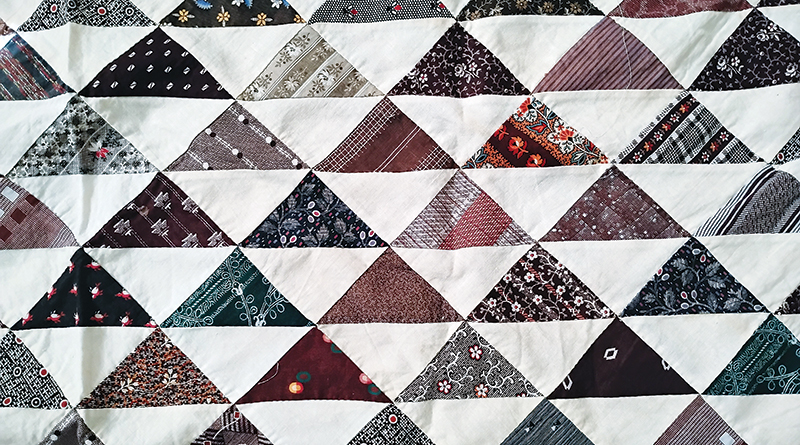
Looking back 150 years ago to 1876 when America celebrated its first centennial, quilts were in the midst of a revolution of their own.
During the 1870s, while Christopher Latham Sholes developed the first commercially successful typewriter (1873), Isaac Merritt Singer patented improvements to his sewing machine then went on to sell it on a payment plan making it affordable to the middle class (1874). Alexander Graham Bell patented his telephone (1876) and quilts were taking on a new look.
Now as the horrors of the Civil War faded, people looked to the future. The 1876 Centennial was celebrated at the Philadelphia Centennial Exposition International Trade Fair: the first one ever held in the United States. It was planned to coincide with the celebration of the 100th anniversary of the signing of the Declaration of Independence. The Centennial Exposition cost over eleven million dollars and covered over 450 acres of Fairmount Park. The exposition was opened by President Grant, on May 10, 1876, and over ten million people viewed the works of 30,000 exhibitors over its six-month run.
Quilts started taking on another look, thanks in part to the development of synthetic dyes. Mauveine, the first synthetic purple dye, accidentally discovered by William Henry Perkin in 1856 gained popularity in the 1870s. Other synthetic colors were fuchsine: a vibrant magenta dye, aniline black: used for textiles and known for its stability, Bordeaux: A red dye derived from aniline and used in both textiles and food coloring, Victoria Blue: A blue dye that became popular for its bright hue and versatility in fabrics. William Henry Perkin went on to synthesize other colors including mint green to replace the toxic Scheele Green dye. Pastel colors also became popular. The hands-down most popular color was brown, in various shades from chocolate, to copper toned madders, to cool browns. Many prints were stripes, plaids, and circles with a touch of red, pink, butterscotch, and blue to make it more interesting. Also, at this time, cheater cloth became popular.
Popular quilt patterns of this period were simplistic using triangles, squares, and rectangles. Quilts made of rows of all three shapes became popular. Patterns like flying geese, hourglass, monkey wrench, and log cabin were popular. Sewing machines could be found in more homes making piecing, applique, and quilting less labor intensive, leaving more time for other endeavors. The Centennial Exposition exposed American women to the art forms of other countries and were heavily influenced by the Japanese. This showed up in their crazy quilts with their hap-hazard fabric placement and embellishments.

Today, as we gear up for the 250 America Celebration, let’s celebrate all the quilters who have made quilts to swaddle a baby, cheer a child, warm an unhoused person, celebrate a special occasion, or honor a dear friend moving away and know that quilts, no matter what the size, skill or colors, are made to reflect the individual who made them and their love to the recipient.
Lois Levihn is the owner of Born Again Quilts. If you have a quilt or textile you’d like her to feature, call her at 260-515-9446 or bornagainquilts@frontier.com

> Read Full Biography
> More Articles Written By This Writer
- Celebrating Centennial Quilts | Around The Frame - June 9, 2026
- Celebrating America’s Semiquincentennial | Around The Frame - May 11, 2026
- This Miserable Winter & How I Survived It | Around The Frame - April 14, 2026