

The Beginning Of St. Therese Church In Waynedale
February is notable for various cultural celebrations and historical observances. But since the Waynedale Community is celebrating its 105th Anniversary, I decided to trace the origins of St. Therese, Church of the Little Flower, in Waynedale.
The local Catholic community began in 1937 when Bishop John F. Noll purchased a wooded plot of ground in the Liberty Gardens addition at Liberty Drive and Lower Huntington Road. At that time, Waynedale was still an unincorporated community of about 3,000 people located six miles southwest of Fort Wayne.
Since the founding of Waynedale in 1921, Catholic families had to go to Fort Wayne to attend Mass. School-age children either attended public schools in Waynedale or had to be driven daily to a Catholic school in Fort Wayne. After numerous requests, early in 1946 Bishop Noll asked the Sisters of Our Lady of Victory in Huntington to take a census of Catholic families in the Waynedale area.
On November 13, 1946, the bishop appointed a discharged Army chaplain, Father Herman A. Schoudel, as pastor with instructions to begin founding a parish.
Although only 31 years old, Fr. Schoudel would prove to be a man of determination, despite many difficulties. The immediate clearing of the new parish plot reportedly was not an easy task since the grounds had been neglected for nearly 10 years. Swamp holes were numerous. Dead trees and stumps had to be removed, some with dynamite. Many trees had to be cut down and sawed into manageable pieces. And the land had to be filled-in and leveled.

When he learned that a post chapel building at Baer Field’s Army Air Base was to be declared government surplus, Fr. Schoudel submitted an application for its purchase. In anticipation of its approval, a basement was excavated on the parish site and a 40×105-foot concrete foundation was poured despite delays during the heavy snows and cold weather of December 1946.
After Fr. Schoudel called most of the Catholic households in the vicinity, the first meeting of the men in the area was held on the evening of March 10, 1947, in the basement of the Wayne Township Engine House on Old Trail Road. A Catholic Founders Club, consisting of men and women, was organized and temporary officers were appointed. Subsequent meetings were held in the Wayne Township School gymnasium and basement, and in the Waynedale Department Store formerly located on Lower Huntington Road.
The new Founders Club officers obtained a lease from the Wayne Township Trustee to use the school gym for Mass on Sunday mornings. The first Mass was celebrated on April 13, 1947. No one seemed to mind using folding chairs and kneeling on the wooden floor to receive Communion. The altar consisted of a folding table erected on the stage. Statues and music stands were set up and removed every Sunday morning. The gym continued to be used as “church” until March 1948. Picnics, socials, and other fundraisers were held on the parish grounds to establish a foundation fund.
Fr. Schoudel traveled to Chicago, New York City, Louisville, and Washington, D.C. in an effort to “speed up” the application submitted for the Army chapel building. Finally, on November 13, 1947 – one year to the date of his appointment as pastor – Bishop Noll was informed the bid had been approved and would be released through the War Assets Administration.
A great deal of preliminary work had to be done to the building at Baer Field that December before the actual moving could begin. Holes were bored into the foundation for steel beams, reinforcing rods were cut loose, the brick chimney and lean-to boiler room were removed, heating pipes were disconnected, and the boiler had to be raised from its foundation. Even the steeple had to be taken down so the 87-ton building could be elevated to about a five-foot height for moving.
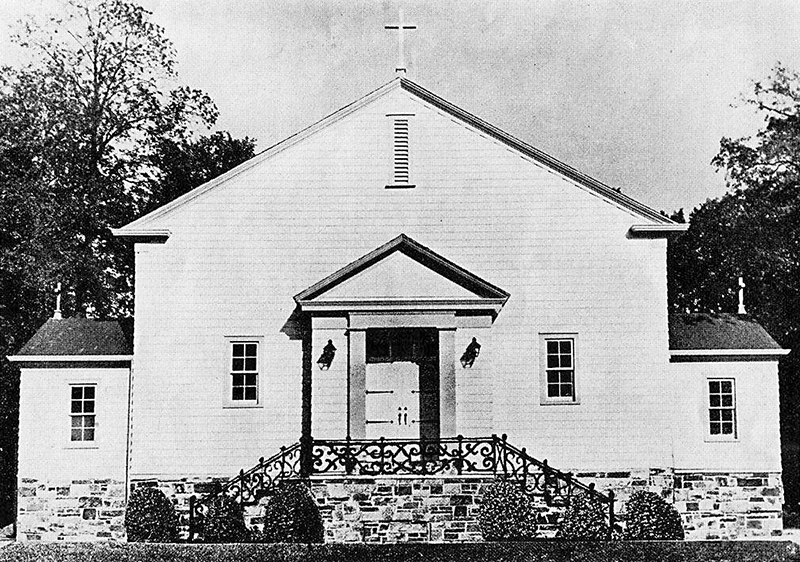
After the many intricate details were carefully completed, the raising of the chapel from its foundation began. But the project soon had to be delayed for several weeks until the soggy soil at Baer Field was frozen solid enough to support the heavy structure. Finally, on January 17, 1948, after many prayers from anxious parishioners for the ground to remain frozen, the chapel was moved slowly on rolling supports down Bluffton Road and installed later that month at its new location to become the first and still only Catholic Church in the Waynedale area.
During the moving period, Fr. Schoudel seriously considered a suitable name for the new parish. He remembered the first chapel in which he said Mass after receiving his initial appointment in the Army was called the Chapel of the Little Flower. Also, he recalled the first Mass he celebrated on European soil was on the outskirts of Lisieux, France, the hometown of St. Therese. In addition, while stationed in the locality, Fr. Schoudel visited the Basilica of St. Therese, Patroness of Soldiers, to celebrate Mass on the premises. So, in his request to the bishop, the new pastor submitted the name of St. Therese, Church of the Little Flower, and received Episcopal approval.
The Army-style chapel had to be renovated and remodeled to comply with the requirements at the time for Catholic churches in this country. By March 7, 1948, the remodeling was complete enough to allow Fr. Schoudel to celebrate the first Mass in the “new” church.
With Bishop Noll presiding, St. Therese Church was solemnly dedicated on October 5, 1948, the original feast day of its patroness.

> Read Full Biography
> More Articles Written By This Writer