

When Did The Red Kettle Become An American Christmas Tradition?
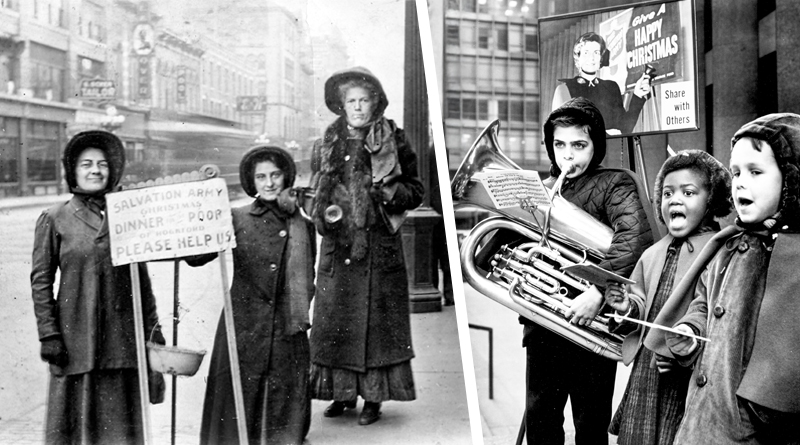
For over 130 years, The Salvation Army Red Kettle Campaign, with its iconic red kettle and bellringer, has been part of the American Christmas tradition. The familiar ting-a-ling sound of a handheld bell can be heard on street corners and outside of shops around the country from November through Christmas Eve.
Began in San Francisco, California, the Red Kettle Campaign spread across the United States and to countries around the world. Today, it continues to provide Christmas meals for those in need and is also a critical funding source for Salvation Army programs held year-round.
The Red Kettle was the brainchild of Canadian-born sailor turned Salvation Army officer, Joseph Rodgers McFee. After a twenty-year sailing career, Joseph sold his ship and moved with his wife, Ruth, to California.
In December 1891, Joseph and Ruth were serving as Salvation Army officers in San Francisco. When his corps wanted to host a Christmas Day dinner for 1,000 of San Francisco’s poor, Joseph accepted the task of raising money to pay for the meals. He remembered the “Simpson’s pot” he saw in Liverpool, England, during his years as a sailor. The pot was a cooking kettle that a man named Simpson placed near the wharf to collect donations for the poor. Joseph decided to use this same technique, and in mid-December 1891, he placed three iron cooking pots on San Francisco’s wharf in and around the ferry depot. He hung signs that read: “Fill the pot for the poor. Free dinner on Christmas Day to 1,000 poor women, children, and unemployed men.” Salvation Army church members stood guard next to the pots.
Joseph’s fundraising strategy was a success. The money from kettles supplemented the donations of food from local merchants and provided lunch and dinner for more than 1,100 of San Francisco’s poorest people.
The scale of the Christmas Dinner program quickly grew. In 1893, the Salvation Army partnered with local churches, and other citizens to raise funds and supplies to feed 4,000 poor women and children. The meal included the distribution of coats, clothing and shoes, food, and wood and coal for heating homes. Santa Claus was there to give toys to the children.

It is hard to imagine a Salvation Army Red Kettle stand without a bellringer.
In 1901, seventeen-year-old Lieutenant Emma Kunkle, a native of Johnstown, PA, was serving an appointment at the New York Bowery Corps. She wanted to attract the attention of passersby as she staffed her assigned kettle stand. “A supervisor suggested that I bang on the kettle with a stick, but that didn’t work very well. So, I suggested a little bell to ring,” she recalled in her later years. Emma’s idea to use a simple handheld bell was just the right cheery sound to be heard on crowded street corners. In addition to the familiar sound of a handbell, some bellringers play brass instruments or sing songs to attract attention and bring joy to others.
Like any enduring campaign, the Red Kettle has relied on memorable slogans to communicate its mission. The first, “Keep the Pot Boiling,” coined around 1894, reflected both the literal goal of feeding the hungry and the era’s expression for making ends meet. Later slogans included “Christmas Cheer and Welfare All Year,” “Sharing Is Caring,” “Need Has No Season,” and today’s enduring brand promise, “Doing the Most Good.”
Midwestern weather can challenge the fortitude of even the heartiest bellringer. Some kettle locations provide shelter from harsh winter weather, but others are out in the open and subject the bellringer to the elements.
Coins clunk as they land in the Red Kettle. Paper money flutters silently inside. But sometimes a donor gives more than pocket change. In 1970 a gold coin was placed in a Morgantown, West Virginia kettle. It is believed that this was an isolated incident and it took more than a decade for the next gold coins to appear in Red Kettles. In 1982, both Bloomington, Indiana and Crystal Lake, Illinois corps were blessed with this valuable donation. In the years since a small shower of gold coins has appeared in Red Kettles across the country, but largely this phenomenon is concentrated in the Midwest. The value of the coins range from $50 to over $1,000 and represents mints across the globe. The South African Krugerrand seems to be the most popular of those received. For more than 40 years these valuable donations have been gratefully received.
Over the decades, countless civic leaders, organizations, and celebrities have supported the campaign. Shirley Temple posed as a bellringer in 1938, followed by generations of public figures, entertainers, and even U.S. First Ladies.
The Red Kettle Campaign has also evolved with technology. Online giving debuted in 2000, followed by credit-card readers at kettle stands in 2008. During the COVID-19 pandemic, contactless giving options such as QR codes and Virtual Red Kettles allowed donors to continue supporting the mission safely and creatively.
Today, donations, whether given in person, online, or digitally, help provide Christmas meals, food boxes, coats, clothing, and toys. Throughout the year, Red Kettle funds support food programs, rent and utility assistance, summer camps for children, services for those experiencing homelessness, and more.
From its humble beginnings on a San Francisco wharf to its place in the digital age, the Salvation Army Red Kettle remains a powerful symbol of compassion. No matter what the size of the gift, every donation helps neighbors help neighbors—and continues a tradition of hope that has lasted for generations.
This article was provided by Nanci Gasiel, Museum Director, The Salvation Army Central Territory Museum.

> Read More Information About Us
> More Articles Written By Our Staff
- Consistent Donations Provide Critical Blood For Patients - February 13, 2026
- Roll In To Support & Play For “Bowl For Kids’ Sake” - February 13, 2026
- Fort Wayne Airport Celebrates Record-Breaking 2025 - February 13, 2026