

THE VOICE OF THE TOWNSHIP
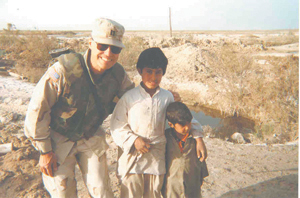
The Wayne Township Trustee’s Office is extremely proud of our efforts to help veterans and their families in this community.‑ Two Wayne Township family members, and one of our closest community partners are directly involved in protecting us from international terrorism through their efforts in the United States Reserves.‑ SGT Shaun A. Crook of the 113th SPT BN will soon be arriving in Afghanistan.‑ Our thoughts and prayers are with him.‑ SPC Jason Hile, Wayne Township’s Operations Administrator serves proudly in Delta Company 1-293rd INF BN, whose unit could be deployed at any time.‑ Mr. Hile is currently completing his two-week annual training.‑ Our Community Partner is Captain Hugh Reusser of the VA Northern Indiana Health Care System, a tremendous resource to this area in assisting homeless veterans, and also past chairperson of the Allen County Homeless Task Force.‑ Captain Reusser recently returned from a one-year deployment in Iraq. I am honored to share his experiences with you. ‑‑‑‑‑‑
(The following is by Capt. Hugh Reusser MS, USAR)
Iraq:‑ its ancient name was Babylon; home to Sumerians, one of the oldest known civilizations; home of the biblical site of the Garden of Eden where Adam and Eve lived; Permanent home of 25 million Iraqi citizens, and today a temporary home for over 100,000 American service men and women.

BAGHDAD, IRAQ-SPRING 2003
“Hey, mister, mister”, cry out the dozen children.‑ A group quickly encircles our four-person team as we exit our Humvee and head toward the neighborhood hospital.‑ My grip on my 9-mm pistol tightens.
The children’s outstretched, upturned palms are thrust into our faces. We give them candy from our MREs (Meals Ready to Eat) and still they ask for more. “It’s like that everywhere you go”, a fellow soldier tells me later, “Kids begging for candy; I wish they’d go away”. Suddenly, a few rounds from an AK-47 assault rifle crack off down the street from where we are parked.‑ Kids scatter and take cover in a nearby alleyway.‑ Our team takes cover, crouched in hasty firing positions around our vehicle.‑ We wait. Silence.‑ After a minute or so, two American soldiers guarding the hospital walk up to us and tell us we are “looking stupid.” The shots came from some local citizen celebrating or signaling neighbors, the soldiers tell us, not to worry.‑ The guards said they acted like us, too, when they first arrived in the city, and even chased the sound of guns firing through the neighborhood.
Welcome to the streets of Baghdad, I thought.
Before being deployed I served in the U.S. Army Reserves as a social worker with the 55th Medical Company, Combat Stress Control team or CSC, located at Fort Benjamin Harrison Reserve Center in Indianapolis, Indiana.‑ Upon being called to active duty in March 2003, I was involuntarily augmented to the 113th Medical Company (CSC) near Los Angeles, California.‑ Our unit’s orders were clear:‑ all of us were being sent to Iraq to serve in Operation Iraqi Freedom.
Our mission as a CSC company was to control combat stress among soldiers in the field via professional services that we provide.‑ Psychiatrists, psychologists, social workers, nurses, occupational therapists and mental health specialists make up two teams called Prevention and Fitness.‑ Prevention teams like mine literally drove to where various fighting forces set up camp in the field of combat.‑ Once there, professional services were provided, including educational sessions for soldiers about the signs and symptoms of combat stress, and what negative or positive impact combat stress may have on troops’ ability to function in the field.‑ We also taught soldiers to use self-help techniques and exercises like deep breathing, relaxation and visual imaging to effectively reduce their own stress levels.‑ Education typically is done within small group sessions.
Individual counseling was reserved for troops who requested it or appeared to need additional help beyond the small group experience.‑ Soldiers who needed more CSC services beyond our day-visit were referred to one of our fitness teams that typically are non-mobile and located in rear areas not so close to the fighting.‑ Fitness teams provided a 24-72 hour respite (not R&R—rest and relaxation) during which the soldier performed light duties in a more relaxed atmosphere. More intensive stress and anger management, relaxation training and counseling also were offered through individual and group sessions.‑ If the soldier’s condition warrants additional medical attention, a referral to the field hospital medical staff was made.
The chief complaint shared by almost all soldiers seen by our team:‑ troops not knowing when they were redeploying (going home).‑ Many were deployed to northern Kuwait in September 2002, and crossed the berm (Iraqi border) when shooting started on March 20, 2003.
They helped clear Baghdad and some shared their experiences of what it was like to be the first American soldiers in town, fighting head-on with Saddam Hussein’s most loyal troop’s. They did not talk freely about their combat stresses, but shared their stress and anger about remaining in Iraq.
Future mental health work among these soldiers who saw most of the heaviest ground fighting will consist of again educating them about the signs and symptoms of combat stress, and explaining how stress can affect veterans and their personal relationships after returning back home.‑ We can tell returning veterans that help is available to those leaving the military through U.S. Department of Veterans Affairs. (Capt. Hugh Reusser served with the U.S. Army Reserves and was on active duty with the 113th Medical Company from April 2003-April 2004, (Combat Stress Control) in Iraq.‑ When not on active duty he is at Health Care for Homeless Veterans at Fort Wayne, Indiana, VA Medical Center.‑ In Iraq his CSC team was attached to the Army’s 3rd Infantry Division (Mechanized) from June 3 to August 3, 2003, near Al Fallujah).
When the Vietnam wall was here several years ago I saw one of my great friends who as I found out that day is a veteran of the Vietnam War.‑ When we parted company, I thanked him for his service to our Country and was shocked to find out later on that I was the first one to ever thank him.‑ During a township conference, the Wayne Township Office was asked to train other Township’s in Veterans Services.‑ I recounted this moment to remind Township officials to thank our veterans for their service, and a man began to sob.‑ This Veteran of fifty years had never been thanked for his service in Korea.
Take time to thank a veteran, they greatly appreciate it!

> Read More Information About Us
> More Articles Written By Our Staff
- Equipping Fort Wayne With Practical Tools For Peacemaking - March 16, 2026
- Is Being A ‘Night Owl’ Bad? - March 16, 2026
- Reminder That Spring Is On The Way… & So Are The Kittens! - March 16, 2026