

RURAL PEARLS
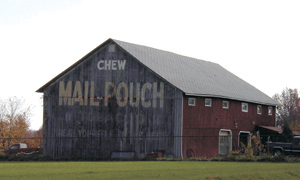
I proceeded to pull into the driveway of that old barn. There I found an older gentleman, wearing Harley Davidson attire, and his son, working. I told them that I passed by this barn several times and wondered what the sign on his barn actually said. He introduced himself as Bob Keesling, a retired member of the Air Guard. He said he was an avid collector of old antique cars and of course, Harley’s, and that he was in the process of restoring this old heavy timber mortise-and-tenon constructed barn. “Finding a someone to rebuild this classic wooden structure is not easy,” Bob said. After inquiring about the barn’s slogan Bob went into another room and found an old poster that depicted a father and a son looking up at their barn with a slogan painted on its side that said, “Chew Mail Pouch Tobacco. Treat Yourself to the Best.” Bob made mention that he had tried several times to find someone to restore his sign but it was to no avail. The Mail Pouch Tobacco Company just sent him back that poster.
I have since learned a lot more about this type of advertising. A crew of painters would come along and paint this slogan on the side of a farmer’s barn in exchange for cash, magazine subscriptions, and/or a good supply of Mail Pouch chewing tobacco. And another option was that the farmer could have the rest of his barn painted. Most Mail Pouch barns have a black background. The red background took more time to paint.
The last living “official” Mail Pouch painter is Harley Warrick. He started painting after returning from the service in World War II. Mr. Warrick has retired from painting barn slogans and is currently living in Belmont, Ohio. He has estimated painting over 20,000 barns and signs.
Eventually there will be no Mail Pouch signs as just a few people have tried it but never stuck with it. Another problem is the tax that is placed on advertising for slogans that are a certain distance from the highway. According to the company that produces Mail Pouch they are not going to pay this expensive tax to continue the slogan on a barn.

After that first step, I was anxious to photograph more old barns. Traveling down the back roads I found a gentleman cleaning up the ditches along the road. I inquired of any old barns in the area and he said that in Pleasant Township, most of the property is owned by either the Springers or Thieles. He directed me to Oscar Springer’s barn across the road. Oscar is 90 years old still living in the house and has owned the property for over 50 years. The barn was built around the early 1900s. The grade or barn approach that is used on this barn, is a ramp built of earthen fill to enable wagons and horses to reach the upper level. The flat terrain of the Midwest allowed few bank barns.
I’m in farming country now. I see fields of corn being harvested and more barns-barns to house cows, tractors, and bales of hay. Barns are practical as well as play a role of beauty in the country. Have you ever noticed the windows on these old barns? Barns that were built more than a century ago had a great deal of time spent in crafting and creating a work of art. Along Yoder Road I noticed color combinations and distinctive window styles. Some of these barns even had elaborate shutters.
Along Muldoon Road there stands a barn that’s not painted. Early barns were not painted. Even if a barn had been painted once, it is often not repainted but instead is left to fade over time. Unpainted, faded, bleached weathered barn timbers have a certain esthetic appeal.
In the early 19th century farmers started painting their barns red. There are several theories why the red color. Some say it was the mix of the paint-stock blood or iron oxide that was mixed with milk to make red. Others say esthetics. Red looked good against their green fields. Another was that red paint was cheap and easy to get. Other colors were also used on barns. White is another popular color. It became popular with the beginning of commercial dairy farming. The white suggests cleanliness and purity-a good association for producing milk.
Unfortunately these landmarks along the countryside of the Midwest are growing smaller every day as the old barns succumb to time and the elements. In 1938 a survey in Wisconsin counted 200,000 old wooden and stone barns. Today, there are about 40,000 still standing. Many are torn down, while others simply fall down or are brought down by winds or fire. Although some barns are being turned into homes and inns, barn preservation groups hope to save this bit of history.

> Read More Information About Us
> More Articles Written By Our Staff
- Equipping Fort Wayne With Practical Tools For Peacemaking - March 16, 2026
- Is Being A ‘Night Owl’ Bad? - March 16, 2026
- Reminder That Spring Is On The Way… & So Are The Kittens! - March 16, 2026